|
 |
||||||||
|
|
Cascadia home | ||||||||
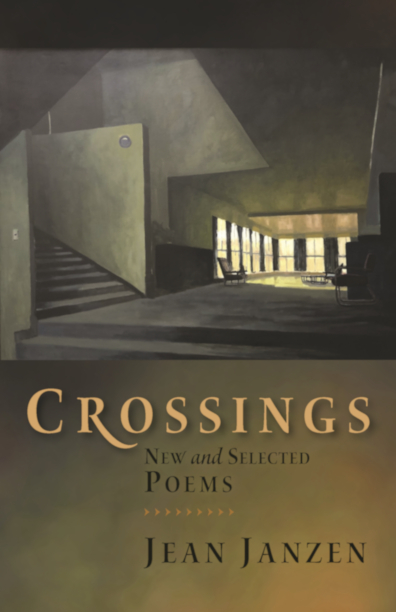
Comments: "Janzen is one of the writers who first awakened me to poetry. It's a great gift to have these poems gathered in a single book. She writes with a grace that only partly disguises a profound complexity, an almost classical music of longing and sounding, praise and sorrow. Her lines are gorgeous and so moving, right through the poems she's writing now, in her nineties.” —Jesse Nathan, Eggtooth Summary (also available through PDF flier): Jean Janzen’s luminous poetry has been shining its way into top magazines and eight books for decades; this volume gathers poems from all those books and a generous set of new poems. Aware of the darkness of this world, Janzen’s poems face it fearlessly yet pursue the consolations and joys that faith, love, desire and language have to offer. In her Crossings title poem, she asks, “The sea so wide and my small boat of words. / What are the lines between the lines?” Each poem hints at answers. Key notes from Janzen’s early poems resonate through all her work: family, including the troubled heritage of her family’s history in what is now Ukraine; childhood and adolescence in Mennonite towns in Saskatchewan, Minnesota, and Kansas; the great questions of faith and doctrine; the mysteries, troubles, and joys of living in a woman’s body in a beautiful, dangerous world. Then also art, especially Vermeer. And music, so important to Jean and her family. And Fresno, hot yet lush when its canals are full, and the big house where she and Louis entertained poets, artists, musicians, and students. At a 1995
event to celebrate publication of Janzen’s Snake in the Parsonage,
Julia Spicher Kasdorf, thinking of Janzen’s many years of putting
others before her own writing, memorably exclaimed, “She ought to be
furious!” It may be hard to find fury in these poems—at least not fury
about her own situation. Yet early and late, Janzen’s poems reckon with
loss, pain, and history, including the traumas her ancestors suffered
during the violence of the Russian Revolution and its aftermath. Her
lovely, tough, life-giving poems offer rich rewards. Praise for Jean Janzen's Poetry "With some (not necessarily all) good poets, one can open their pages at random, read a line or stanza detached from its context, yet be rewarded by incontestable poetry. Janzen is such a poet.” —Denise Levertov, This Great Unknowing: Last Poems “Janzen’s
poetry speaks of love as . . . a radical wholeness that radiates
outward and does not fence-off boundaries between what is sacred and
what profane, what belongs to body and what to spirit.” —Peter
Everwine, Pulling the Invisible but Heavy Cart: Last Poems “Janzen writes our songs. As you read these poems, you realize they are prayers ‘smoldering in your chest’; if you contemplate them too long, they will lean you low, so low you will be able to ‘put your ear / against the belly of the earth, to hear / it rumble, to hear it sigh.’’ —Rudy Wiebe, Come Back Market: In the final poem in Crossings, Janzen tells us “the secret of the story / is love, that even as we sleep, / its tides carry us in a wild safety.” This book is for anyone draw to that secret. Shelving: Poetry—of
body and soul, hunger, childhood, aging; Anabaptist-Mennonite
literature; Spirituality—Mennonite. BISAC: Poetry; RTM: 640
Poetry. Publisher: Cascadia
Publishing House LLC |
|||||||||
|
|
|||||||||